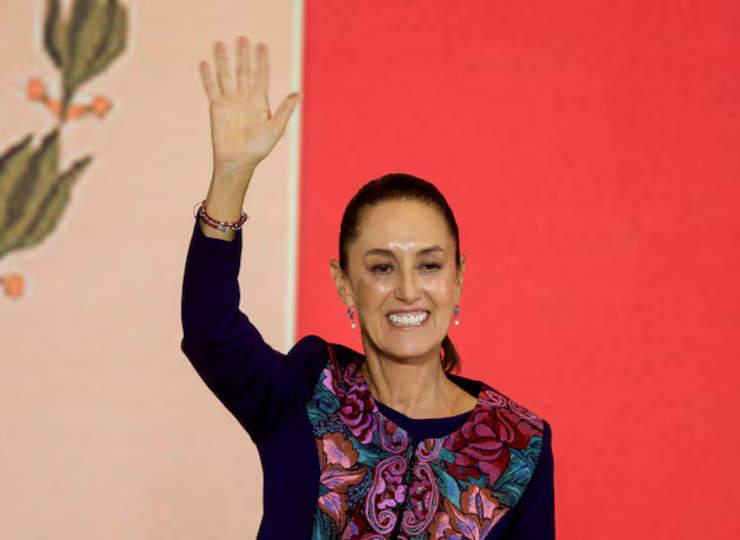
Sheinbaum’s second government report contains many figures. Understanding it requires only two: 0.7%—Mexico’s 2025 growth rate—and 69%—her approval around the time of the report.
By traditional political logic, a country with almost no growth rarely produces a highly popular president. Mexico is doing the opposite: investors are cautious, firms delay projects, growth is slow, yet most voters still trust the president. Mexicans are not indifferent to the economy; how they judge whether the economy is “better” has changed.
0.7%2025 growth
69%Approval
+154%Min. wage cumulative
7.8%FDI for new projects
Sheinbaum’s second report: the political distance between 0.7% and 69%
On 1 September she stood in the National Palace and spoke of minimum wages, scholarships, pensions, housing, rail, schools and public investment—not of 0.7% or why private investment hesitates. GDP does not appear on a supermarket receipt; pensions and scholarships do. Foreign investment data do not hit household accounts at month-end; the minimum wage does.
Since the Fourth Transformation, the minimum wage has risen about 154% in cumulative terms. Sheinbaum continues to expand education, housing and social security, and plans a gradual move to a 40-hour week by 2030. So 0.7% and 69% are not a pure contradiction: one measures new national wealth; the other measures whether people feel the government is on their side.
The state becomes visible again
For decades the main promise was: stay open, attract investment, keep fiscal order, and growth will eventually lift everyone. That model delivered exports, plants and macro stability, but gains were uneven. Northern industrial cities joined US supply chains; many low-income households saw exports rise while wages and public services did not keep up.
AMLO rewrote the contract. He did not ask voters first to believe in growth and wait for trickle-down. He raised the minimum wage, expanded cash transfers, and stressed the state’s duty to those the old model left out. The deepest effect was not only higher household income—it made the state visible again: a pension payment, a scholarship, a place in the national priority list.
Key: Sheinbaum inherits that trust. Inheriting trust is more dangerous than building it.
Where does redistributable wealth come from?
AMLO could say the old model failed and wealth must be redistributed. Sheinbaum must answer where redistributable wealth comes from. She stresses fiscal discipline and the “Plan México” industrial parks. Social spending can expand in a year; industrial capacity takes years—power, water, roads, ports, skilled labour, enforceable contracts, stable trade rules.
H1 2026 FDI was about $35bn, seemingly a record, but only about 7.8% went to new projects; most was reinvestment by firms already in Mexico. Old firms have not fled; new bets hesitate over USMCA uncertainty, tariffs, energy, security and the rule of law. A country can coast without heavy new investment for a while; it cannot keep raising wages, expanding welfare and creating enough new jobs that way forever.
AMLO’s task was to show the old model was unfair. Sheinbaum’s is to show a fairer model can also grow. One is about who gets the wealth; the other is about how new wealth is created.
Fairness cannot wait forever for growth
Only extending transfers can hold the base but exhaust fiscal space; cutting wages and welfare to chase investment would break the social promise. The hard path is both higher wages and higher productivity—education and training, industrial power and water, logistics, credible justice, higher-value industries. Otherwise “shared prosperity” stresses sharing more than prosperity.
Sixty-nine percent approval means most Mexicans have not written her off over slow growth. About 65% back her handling of US relations; security and corruption still worry the public; approval is down roughly ten points from a year ago. People will give time; they will not wait forever.
Mexico has already rejected the idea that growth alone makes distribution irrelevant. It must not slide into the opposite: that fairer distribution makes growth irrelevant. Growth without distribution breeds disappointment; distribution without growth eventually loses its fiscal base. The distance between 0.7% and 69% is the rest of her term. Mexico proved growth cannot replace fairness. She must prove fairness cannot wait forever for growth.
Nel secondo rapporto di Sheinbaum bastano due numeri: 0,7% di crescita nel 2025 e 69% di approvazione. Economia quasi ferma, fiducia ancora alta. Il modo in cui i messicani giudicano se «l’economia va meglio» è cambiato.
0,7%Crescita 2025
69%Approvazione
+154%Salario minimo cumulato
7,8%IDE nuovi progetti
Secondo rapporto di Sheinbaum: distanza tra 0,7% e 69%
Il 1° settembre ha parlato di salari minimi, borse, pensioni, alloggi e opere pubbliche più che dello 0,7%. Il PIL non compare sullo scontrino; pensioni e borse sì. Dal Fourth Transformation il salario minimo è salito circa del 154% cumulato. 0,7% e 69% non sono una pura contraddizione: uno misura la ricchezza nuova; l’altro se la gente sente il governo dalla propria parte.
Lo Stato torna visibile
Per decenni la promessa era: apertura, investimenti, ordine fiscale, e la crescita avrebbe sollevato tutti. Export e stabilità sì; redistribuzione ineguale. AMLO ha riscritto il contratto: alzare salari e trasferimenti, non attendere il trickle-down. L’effetto più profondo è che lo Stato è di nuovo visibile.
Punto chiave: Sheinbaum eredita questa fiducia. Ereditare è più pericoloso che costruire.
Da dove viene la ricchezza da redistribuire?
Gli IDE del primo semestre 2026 intorno a 35 miliardi di dollari, ma solo circa il 7,8% in progetti nuovi. Le imprese vecchie restano; le nuove scommettono poco. Il compito di AMLO era dimostrare l’iniquità del vecchio modello; quello di Sheinbaum è dimostrare che un modello più equo può anche crescere.
L’equità non può aspettare per sempre la crescita
Solo trasferimenti tengono la base ma consumano lo spazio fiscale; tagliare salari e welfare per attrarre investimenti rompe la promessa sociale. Servono salari più alti e produttività più alta insieme. Il Messico ha già respinto l’idea che la sola crescita renda irrilevante la distribuzione. Non deve scivolare nell’opposto. La distanza tra 0,7% e 69% è il resto del mandato.
En el segundo informe de Sheinbaum bastan dos cifras: 0,7% de crecimiento en 2025 y 69% de aprobación. Casi no hay crecimiento y la mayoría sigue confiando. Cómo miden los mexicanos si «la economía va mejor» ya cambió.
0,7%Crecimiento 2025
69%Aprobación
+154%Salario mínimo acumulado
7,8%IED proyectos nuevos
Segundo informe de Sheinbaum: distancia entre 0,7% y 69%
El 1 de septiembre habló de salarios mínimos, becas, pensiones, vivienda y obras más que del 0,7%. El PIB no aparece en el ticket; las pensiones y becas sí. Desde la Cuarta Transformación el salario mínimo ha subido cerca de un 154% acumulado.
El Estado vuelve a ser visible
Durante décadas la promesa fue apertura, inversión y orden fiscal; la distribución fue desigual. AMLO reescribió el contrato: subir salarios y transferencias, no esperar el goteo. El efecto más profundo es que el Estado vuelve a verse.
Clave: Sheinbaum hereda esa confianza. Heredarla es más peligroso que construirla.
¿De dónde sale la riqueza a repartir?
La IED del primer semestre de 2026 rondó 35.000 millones de dólares, pero solo ~7,8% fue a proyectos nuevos. El legado de AMLO fue probar que el modelo viejo era injusto; el de Sheinbaum es probar que uno más justo también puede crecer.
La equidad no puede esperar para siempre al crecimiento
Solo transferencias agotan el margen fiscal; recortar salarios y bienestar rompe la promesa. Hacen falta salarios más altos y productividad más alta a la vez. México ya rechazó que el solo crecimiento haga irrelevante la distribución. No debe caer en lo contrario. La distancia entre 0,7% y 69% es el resto del mandato.
En el segundo informe de Sheinbaum bastan dos cifras: 0.7% de crecimiento en 2025 y 69% de aprobación. Casi no hay crecimiento y la mayoría sigue confiando. Cómo miden los mexicanos si «la economía va mejor» ya cambió.
0.7%Crecimiento 2025
69%Aprobación
+154%Salario mínimo acumulado
7.8%IED proyectos nuevos
Segundo informe de Sheinbaum: distancia entre 0.7% y 69%
El 1 de septiembre habló de salarios mínimos, becas, pensiones, vivienda y obras más que del 0.7%. El PIB no aparece en el ticket; las pensiones y becas sí. Desde la Cuarta Transformación el salario mínimo ha subido cerca de un 154% acumulado.
El Estado vuelve a ser visible
Durante décadas la promesa fue apertura, inversión y orden fiscal; la distribución fue desigual. AMLO reescribió el contrato: subir salarios y transferencias, no esperar el goteo. El efecto más profundo es que el Estado vuelve a verse.
Clave: Sheinbaum hereda esa confianza. Heredarla es más peligroso que construirla.
¿De dónde sale la riqueza a repartir?
La IED del primer semestre de 2026 rondó 35,000 millones de dólares, pero solo ~7.8% fue a proyectos nuevos. El legado de AMLO fue probar que el modelo viejo era injusto; el de Sheinbaum es probar que uno más justo también puede crecer.
La equidad no puede esperar para siempre al crecimiento
Solo transferencias agotan el margen fiscal; recortar salarios y bienestar rompe la promesa. Hacen falta salarios más altos y productividad más alta a la vez. México ya rechazó que el solo crecimiento haga irrelevante la distribución. No debe caer en lo contrario. La distancia entre 0.7% y 69% es el resto del mandato.
Dans le deuxième rapport de Sheinbaum, deux chiffres suffisent : 0,7 % de croissance en 2025 et 69 % d’approbation. Croissance quasi nulle, confiance encore majoritaire. La façon de juger si « l’économie va mieux » a changé.
0,7%Croissance 2025
69%Approbation
+154%Salaire minimum cumulé
7,8%IDE projets nouveaux
Deuxième rapport de Sheinbaum : distance entre 0,7 % et 69 %
Le 1er septembre, elle a parlé salaires minimums, bourses, pensions, logement et travaux plus que du 0,7 %. Le PIB n’apparaît pas sur le ticket ; pensions et bourses oui. Depuis la Quatrième Transformation, le salaire minimum a augmenté d’environ 154 % en cumulé.
L’État redevient visible
Pendant des décennies, la promesse était ouverture, investissement, ordre budgétaire ; la répartition était inégale. AMLO a réécrit le contrat : hausser salaires et transferts, ne pas attendre le ruissellement. L’effet le plus profond est que l’État redevient visible.
Point clé : Sheinbaum hérite de cette confiance. L’hériter est plus dangereux que la construire.
D’où vient la richesse à redistribuer ?
Les IDE du premier semestre 2026 autour de 35 milliards de dollars, mais seulement ~7,8 % en projets nouveaux. La tâche d’AMLO était de prouver l’injustice de l’ancien modèle ; celle de Sheinbaum est de prouver qu’un modèle plus juste peut aussi croître.
L’équité ne peut pas attendre indéfiniment la croissance
Les seuls transferts épuisent l’espace budgétaire ; baisser salaires et prestations casse la promesse sociale. Il faut salaires plus élevés et productivité plus élevée ensemble. Le Mexique a déjà rejeté l’idée que la seule croissance rende la répartition secondaire. Il ne doit pas basculer dans l’inverse. La distance entre 0,7 % et 69 % est le reste du mandat.